Custom Web Application Development | Boost Your Business
Created at: 2025-08-06
# Custom Web Application Development | Boost Your Business
When you hear "custom web application development," what comes to mind? It’s simply the process of building software from the ground up, specifically for your company's unique way of doing things.
Think of it this way: you could buy a suit off the rack, or you could have one custom-tailored. The off-the-rack suit might fit okay, but the tailored one is designed to fit you perfectly. A custom web application is that tailored suit—it’s built to match your business operations precisely, giving you a real competitive edge because your tools finally fit your processes, not the other way around.
## Custom Application vs Off-The-Shelf Software
To really understand the value of a custom build, it helps to see how it stacks up against pre-built, off-the-shelf software. While packaged solutions have their place, they often come with significant trade-offs that aren't apparent at first glance.
The table below breaks down the key differences.w
| Feature | Custom Web Application | Off-The-Shelf Software |
| :--- | :--- | :--- |
| **Functionality** | Built specifically for your unique workflows and needs. | Generic features designed for a broad market. |
| **Scalability** | Designed to grow with your business and handle increased load. | Limited scalability; may require upgrading to a new system. |
| **Integration** | Can be seamlessly integrated with your existing tools and systems. | Integration can be difficult, costly, or impossible. |
| **Competitive Edge** | Creates a unique operational advantage that competitors can't replicate. | You use the same tools as everyone else; no advantage. |
| **Cost** | Higher initial investment, but lower long-term costs due to efficiency. | Lower upfront cost, but hidden costs from subscriptions and workarounds. |
| **Flexibility** | Highly adaptable; you can add or modify features as needed. | Rigid and inflexible; you're stuck with the features provided. |
Ultimately, the choice comes down to strategy. Off-the-shelf software can be a quick fix, but a custom application is a long-term investment in your company's unique operational DNA.
### Why Off-The-Shelf Software Often Fails Growing Businesses
Many businesses start out with off-the-shelf software. It makes sense at first. A generic project management tool or a standard e-commerce plugin seems cheap and easy to set up. They promise a quick solution with a bunch of features that solve common problems.
But as a business grows and its needs get more specific, that "one-size-fits-all" solution often becomes a "one-size-fits-none" headache.
The biggest problem with generic software is its rigidity. You’re forced to bend your unique workflows to fit the software's limitations. This leads to clumsy workarounds, hours of manual data entry to bridge gaps between systems, and paying for bloated features you never touch while still lacking the one or two functions you actually need. It’s like trying to build a complex piece of furniture with just a single screwdriver when what you really need is a full toolkit.
### The Hidden Costs Of "Good Enough"
This friction adds up. The compromises you make to accommodate generic software can quietly suffocate productivity and new ideas. Your team ends up fighting the software instead of focusing on their real jobs.
Here’s what that looks like in practice:
* **It Can’t Keep Up:** Pre-built software often chokes when faced with a growing user base, more data, or higher transaction volumes, causing slowdowns and crashes.
* **It Doesn’t Play Well With Others:** Trying to connect generic software to your other essential business systems can be a nightmare, creating isolated data islands.
* **It Offers Zero Competitive Advantage:** When you use the same tools as your competitors, you can't outperform them. Real innovation comes from having better processes, not the same ones.
> A custom web application, on the other hand, is built to embrace your company’s specific processes. It transforms your unique operational model from a challenge into a strategic asset, empowering your team to work more efficiently and effectively.
### A Strategic Investment, Not Just An Expense
Choosing to build a custom web application is a strategic decision, not just a line item in your IT budget. It’s an investment in a solution that grows with you, delivering long-term value that easily surpasses the initial cost.
Businesses are catching on. The demand for solutions built for a perfect fit is exploding as more companies hit the wall with generic tools. The global custom software development market, valued at around **USD 43.21 billion in 2024**, is expected to soar to **USD 334.49 billion by 2034**. This isn't just a trend; it's a massive shift toward building unique digital assets. You can dig into the numbers and what’s driving this growth in the full [Precedence Research report](https://www.precedenceresearch.com/custom-software-development-market).
## The Real Business Impact Of A Custom Solution

It’s one thing to talk about a "perfectly fitting" tool in theory. It’s another thing entirely to see how it directly impacts your operations and, ultimately, your bottom line. The true value of **custom web application development** isn't just about having something unique; it's about turning your specific way of doing business into a competitive advantage that off-the-shelf software could never provide.
These aren't just minor tweaks. We're talking about fundamental improvements in how your business runs, leading to real gains in productivity, security, and your ability to grow. The effects ripple through the entire organization, from the people on the front lines to the leadership team making strategic decisions.
### Boost Efficiency With Purpose-Built Workflows
Right out of the gate, the most tangible benefit you'll see is a massive leap in efficiency. Think about it: generic software forces your team to adapt to its rigid, often clumsy workflows. A custom solution is built the other way around—it's designed to support your team's most effective process.
Let's take a real-world example. I once worked with a retail business that was drowning in manual inventory counts. Staff were wasting hours every single week with clipboards and spreadsheets. This led to constant stock-outs, lost sales, and over-ordering products that just sat on the shelves.
A custom inventory app changed everything for them.
* **Real-time Tracking:** They could scan barcodes with a simple mobile device, and the central database updated instantly.
* **Automated Reordering:** The system was programmed to automatically flag items for reorder when stock hit a specific level.
* **Sales Integration:** It connected directly to their point-of-sale, giving them a live, accurate picture of what was on hand.
That one application reclaimed thousands of work hours a year, slashed costly human errors, and gave management the accurate data they needed to make smarter purchasing decisions. The business became leaner and more profitable, almost overnight.
### Achieve Seamless And Limitless Scalability
Your business isn't standing still, so why should your software? One of the biggest traps of generic solutions is their inability to scale. When your user base explodes or your data volume swells, pre-built software often hits a wall. This forces you into a painful, expensive migration to a whole new system right when you should be focused on growth.
> A custom web application, on the other hand, is built with your future in mind. Its architecture is engineered to handle not just today's workload, but your projected load for years to come. This foresight ensures your tech is an asset, not a bottleneck.
Whether you're expanding into new territories or bracing for a **500% increase** in traffic, a well-built custom app can handle it. Adding new features or beefing up capacity becomes a planned, manageable evolution instead of a frantic, all-hands-on-deck emergency.
### Enhance Data Security And Compliance
In today's world of non-stop cyber threats, using the same software as thousands of other companies can paint a target on your back. Hackers actively hunt for vulnerabilities in popular platforms because it gives them access to many victims at once. A custom application gives you a huge security advantage simply by being different.
Because your codebase and architecture are completely unique, it's an unknown territory for attackers looking for a quick win. Better yet, you can build security measures specifically for your kind of data and regulatory needs, whether it's HIPAA for patient information or [GDPR](https://gdpr-info.eu/) for customer data. You're in complete control of your security, from user access rules to data encryption, creating a much stronger defense than any one-size-fits-all product can offer.
## Your Custom Development Journey From Start To Finish
Building a custom web application from scratch can feel like a massive undertaking. Where do you even begin? The good news is that it’s not as intimidating as it looks when you have a clear roadmap. By breaking the entire lifecycle down into distinct phases, we can turn a complex project into a series of logical, manageable steps.
This journey is about much more than just writing code. It's a structured process that transforms a core business idea into a functional, valuable tool. Each phase builds on the last, from figuring out the *why* behind the project to making sure it runs perfectly long after launch. Understanding this roadmap helps you stay in the driver's seat, making smart decisions that lead to a successful app.
### Phase 1: Discovery And Strategy
Every great project starts with a conversation, not a line of code. The Discovery and Strategy phase is all about laying the foundation. This is where we translate your business goals into a technical blueprint, digging deep to understand the problem you're solving and what a "win" actually looks like for you.
This phase is hands-on and collaborative. Key activities include:
* **Stakeholder Interviews:** We’ll sit down with your key team members to really get to the bottom of their pain points, daily workflows, and what they hope to achieve with the new app.
* **Market and Competitor Analysis:** We'll take a hard look at what’s already out there. This helps us spot gaps in the market and find opportunities to build something truly unique and valuable.
* **Defining Scope and the MVP:** Together, we’ll define the absolute core features needed for the first version—the **Minimum Viable Product (MVP)**. This keeps the initial launch focused and gets you to market faster.
Honestly, this first phase is arguably the most important. A thorough discovery process heads off expensive changes down the line and ensures the final product is perfectly aligned with what your business actually needs.
### Phase 2: UI/UX Design
Once we have a solid strategy, the spotlight turns to the people who will actually use the application. User Interface (UI) and User Experience (UX) design is about creating an app that isn't just nice to look at, but is also intuitive, logical, and easy to navigate. Great design makes all the difference in user adoption.
A good UI/UX process makes abstract ideas feel real. The process typically moves from a basic sketch to a polished, interactive model, as you can see below.
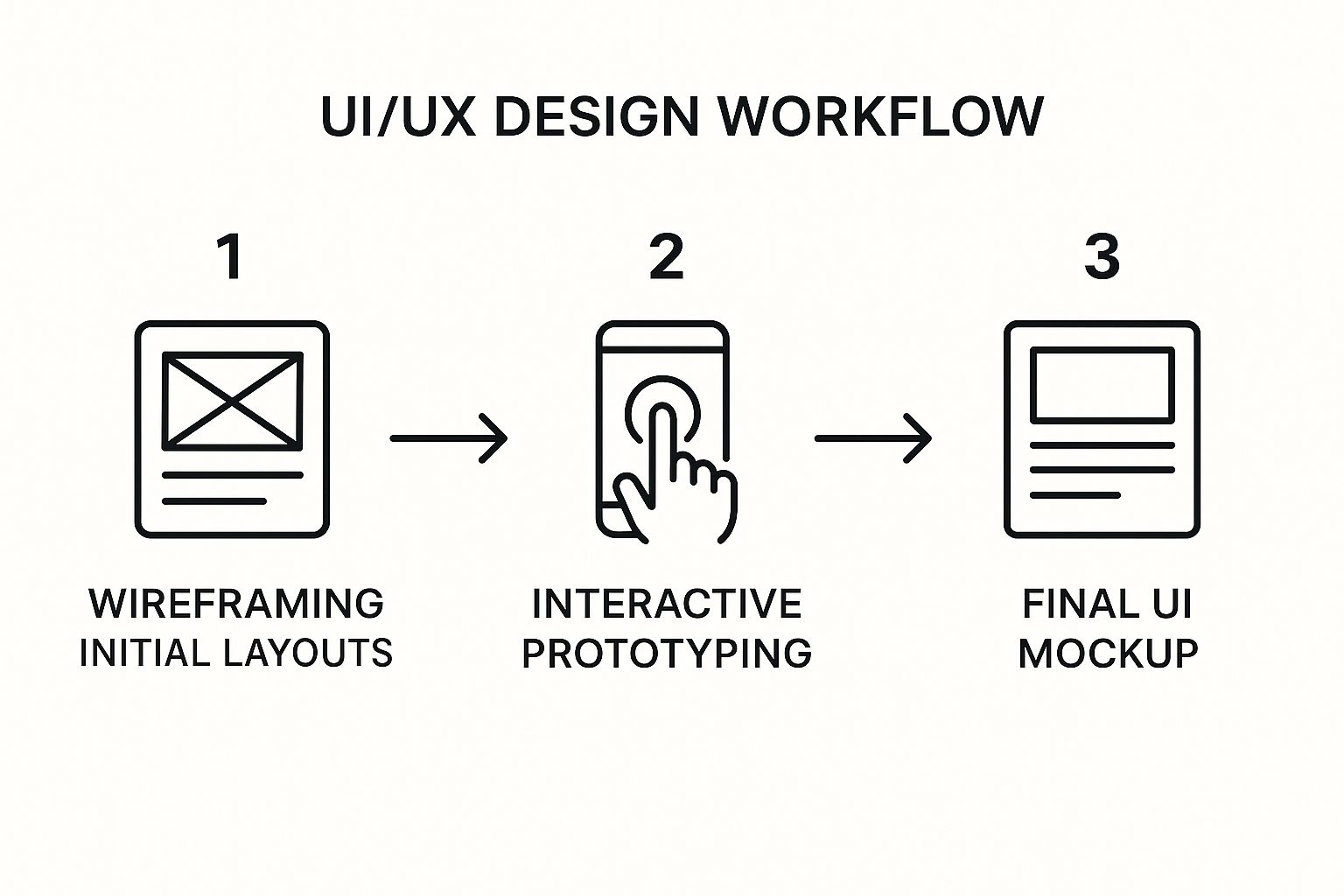
Following this structured flow—from wireframe to final mockup—lets us validate and tweak the app's look, feel, and functionality before a single line of code is written. It saves a ton of time and money.
### Phase 3: Development And Coding
This is where the magic happens and the blueprint comes to life. Working from the strategic plan and the UI/UX designs, our developers get to work building the application's architecture. They’ll write the front-end code that users see and interact with, as well as the back-end code that handles all the heavy lifting like business logic and data management.
We typically use an agile development approach here, breaking the project into small, two-week cycles called "sprints." This iterative process allows for constant feedback and quick adjustments, keeping the project flexible and on track. Clear and consistent communication between you and the development team is vital during this phase to make sure the build stays true to your vision.
> Custom solutions are no longer a niche market; they're becoming essential. The custom software development market is projected to more than double between 2025 and 2030, jumping from about **$52.84 billion to $146.18 billion**. This surge is fueled by businesses needing tools that can provide real-time analytics and support modern, flexible work. You can [discover more market growth insights from Grand View Research](https://www.grandviewresearch.com/industry-analysis/custom-software-development-market-report).
### Phase 4: Testing And Quality Assurance
Before any application meets its users, it has to go through boot camp. The Quality Assurance (QA) phase is a meticulous process designed to hunt down and eliminate bugs, usability hiccups, and security flaws. This is how we ensure the final product is reliable, performs well under pressure, and gives users a seamless experience.
Testing isn’t just one step; it’s a whole battery of checks:
1. **Functional Testing:** We verify that every single feature works exactly as it’s supposed to, based on the project plan.
2. **Compatibility Testing:** We make sure the app works flawlessly across different browsers, devices (desktops, tablets, phones), and operating systems.
3. **Performance Testing:** This is where we stress-test the application, simulating heavy user loads to prevent crashes or slowdowns during peak traffic.
4. **Security Testing:** We actively probe for vulnerabilities that could be exploited, protecting your business data and your users' information.
A rigorous QA process is non-negotiable. It’s what separates a professional, trustworthy application from a frustrating, amateur one.
### Phase 5: Deployment And Post-Launch Support
This is the final hurdle: moving the finished, tested application from a development environment to a live server where your users can access it. We plan this "go-live" moment carefully to ensure a smooth transition with minimal to no downtime.
But the journey doesn't end when you launch. **Post-launch support** is what guarantees long-term success. This ongoing partnership involves monitoring the app's performance, squashing any bugs that pop up in the real world, and planning for future updates and new features. A great development partner sticks around to make sure your application continues to deliver value and grows right alongside your business.
## Choosing The Right Tech Stack For Your Project

If you think of your custom web app as a high-performance vehicle, then its technology stack is the engine. It’s the combination of programming languages, frameworks, and tools that power the entire machine. Getting this part right is crucial, as it has a direct line to your app's speed, its ability to grow with your business, and even how much it costs to maintain down the road.
Another way to look at it is like building a house. You wouldn't use the same materials for the foundation as you would for the electrical wiring or the paint on the walls. In **custom web application development**, these "materials" are the technologies, and each one has a very specific job to do.
You don't need to become a developer overnight. The goal here is to get familiar with the core components so you can have productive, confident discussions with your technical team. This knowledge allows you to ask the right questions and truly understand how their decisions will impact your project's future.
### The Three Core Layers Of A Tech Stack
At its heart, every web application is built with three fundamental layers. Each one relies on different technologies to do its job, and they all have to communicate seamlessly for anything to work.
* **The Front-End (Client-Side):** This is everything your users see and interact with. It's the visual interface—the buttons they click, the forms they fill out, and the layout of the pages in their browser. The front-end is all about creating an intuitive and enjoyable user experience.
* **The Back-End (Server-Side):** This is the hidden powerhouse working behind the scenes. The back-end handles all the heavy lifting, like business logic, user authentication, data processing, and talking to the database. It’s the engine under the hood that makes it all go.
* **The Database:** This is the application’s memory. It’s where all the important information—from user profiles and product inventories to order histories—is stored, organized, and retrieved.
Understanding these layers helps pull back the curtain on the development process. So, when your team talks about using React for the front-end and Python for the back-end, you’ll have a clear picture of what parts of the "house" they're building.
### Popular Technology Choices Explained
While the list of available technologies is nearly endless, a handful have become industry mainstays because of their power, flexibility, and strong community support. Your development partner will recommend a stack based on your project's unique needs, but knowing the key players gives you a serious advantage.
To help you get familiar, here is a quick look at some of the most common technologies and what they do.
| Layer | Technology Example | Primary Purpose |
| :--- | :--- | :--- |
| **Front-End** | **React.js** | A JavaScript library created by Facebook, known for building dynamic, high-performance user interfaces with reusable components. |
| **Front-End** | **Vue.js** | A progressive JavaScript framework that is easy to learn and excellent for single-page applications and interactive elements. |
| **Back-End** | **Node.js** | A JavaScript runtime that is fast and efficient, making it ideal for real-time applications like chat apps and live dashboards. |
| **Back-End** | **Python (with Django)** | A versatile language praised for its clean syntax and powerful frameworks like Django, perfect for complex, data-heavy apps. |
| **Database** | **SQL (e.g., PostgreSQL)** | Structured Query Language databases are great for applications requiring structured data and complex queries, like e-commerce stores. |
| **Database** | **NoSQL (e.g., MongoDB)** | Ideal for applications with large amounts of unstructured data or those needing high flexibility and scalability, like social media apps. |
At the end of the day, picking the right stack is a major strategic decision. It isn't just about what's trendy; it’s about what is genuinely best suited to solve your specific business problem, handle your expected traffic, and allow for future growth without having to start from scratch.
### How Technology Choices Impact Your Business
So, why does any of this really matter to the business? Because the technologies you choose today will have long-term consequences. A stack that is slow, clunky, or difficult to scale can quickly become a business liability. On the other hand, a well-chosen stack is a powerful asset that fuels your growth.
For example, a stack built with **Node.js** might be the perfect fit for an application that needs to support thousands of simultaneous user connections. But a different app, one focused on heavy data analysis, would likely get more value from **Python's** powerful data science libraries. The key is always to align the technology with the business goal.
What's more, artificial intelligence is now playing a bigger role in these decisions. AI is being used to improve code quality, automate tedious development tasks, and speed up testing. These innovations can shorten development timelines and help businesses get to market faster. To see how AI is shaping the industry, you can [learn more about custom development trends from Precedence Research](https://www.precedenceresearch.com/custom-software-development-market).
## How To Budget For Custom Application Development
<iframe width="100%" style="aspect-ratio: 16 / 9;" src="https://www.youtube.com/embed/u6QfIXgjwGQ" frameborder="0" allow="autoplay; encrypted-media" allowfullscreen>iframe>
Let's get straight to the point. For any business thinking about a bespoke solution, the first question is always the same: "How much is this going to cost?" Unlike off-the-shelf software with a set price, **custom web application development** doesn't come with a simple price tag. It's an investment, and its cost is directly tied to the complexity and value you need to build.
Think of it this way: you wouldn't expect a simple, handmade bookshelf to cost the same as an intricate, floor-to-ceiling entertainment center. The final price depends on the materials, the hours of skilled labor, and the complexity of the design. It's the exact same principle with software. Your application's budget will be shaped by a few key factors that dictate the project's scope and effort.
### Core Factors Influencing Your Budget
Before you can build a realistic budget, you need to understand what actually drives the cost. The price isn't pulled out of thin air; it’s a reflection of the time and expertise needed to build a tool that fits your business perfectly.
Here are the main cost drivers:
* **Project Complexity:** This is the single biggest factor. A simple internal tool with a handful of data entry forms is a world away from a sophisticated, customer-facing portal that has to manage real-time data and secure payments.
* **Number of Features:** Every single feature, from a basic user login to an advanced reporting dashboard, adds to the development time and, consequently, the cost. The more you need the application to do, the more it will cost to build.
* **UI/UX Design Level:** A basic, functional interface is always cheaper than a highly polished, custom-branded user experience filled with smooth animations and intuitive workflows. That said, investing in great UI/UX almost always pays for itself through better user adoption and satisfaction.
* **Third-Party Integrations:** Do you need your new app to talk to your existing systems, like a CRM, an ERP, or a payment gateway? Each connection adds a layer of complexity. These integrations require careful planning and development work to make sure data flows smoothly and reliably.
### Tiers Of Application Complexity And Cost
To help make this more concrete, we can group projects into three general tiers. These estimates should give you a realistic starting point for what kind of investment you might be looking at for your own **custom web application development** project.
> Custom development is a serious investment, and it’s a market that continues to grow, especially in North America. The region makes up over **34%** of the global market share, thanks to a high rate of IT adoption. In fact, the U.S. custom software market alone is on track to hit **USD 84.82 billion by 2034**. You can dig deeper into [the drivers behind this market growth on Codewave](https://codewave.com/insights/custom-software-development-market-growth-forecast/).
Your project's budget will most likely fall into one of these ranges.
| Project Tier | Description & Examples | Estimated Timeline | Estimated Cost Range |
| :--- | :--- | :--- | :--- |
| **Simple** | Basic apps with just a few pages, straightforward logic, and minimal data storage. *Example: A landing page with a contact form or a small internal knowledge base.* | **4–8 Weeks** | **$10,000 – $25,000** |
| **Moderate** | Applications with more features like user profiles, some third-party integrations, and more involved business logic. *Example: A customer portal for tracking orders or an e-commerce site.* | **3–6 Months** | **$25,000 – $75,000** |
| **Complex** | Enterprise-level systems with a wide array of features, advanced security, real-time data processing, and multiple complex integrations. *Example: A full-fledged SaaS product or a custom ERP system.* | **6–12+ Months** | **$75,000+** |
At the end of the day, custom web application development isn't a commodity purchase. It’s a strategic investment in a unique asset—one designed to boost efficiency, solve your specific problems, and give you a real competitive edge. Once you understand these cost factors, you can create a budget that aligns perfectly with the value you expect to get in return.
## Best Practices For A Successful Project Partnership

Hiring a world-class development team is a fantastic start, but it's only half the equation. The other half is you. The real magic happens when you and your development partner build a strong, collaborative relationship. This partnership is what separates the projects that soar from the ones that just get by.
To make sure your **custom web application development** journey is a success, you need to be more than just the person who signs the checks. Your active involvement provides the essential business insights, feedback, and vision that developers need to build something truly great. By following a few key practices, you can set your project up to launch on time, stay on budget, and exceed everyone's expectations.
### Define A Clear And Realistic Vision
Before anyone writes a single line of code, you need to have an incredibly clear idea of what you're trying to build and why. A vague goal like "we need a better system" just won't cut it. You have to nail down the specific problem you're solving, what core features are non-negotiable for the first version (your **Minimum Viable Product**, or **MVP**), and what success actually looks like in concrete, measurable terms.
> Your development partner is an expert in building software, but you are the expert on your business. A well-defined vision acts as the project’s North Star, guiding every technical decision and ensuring the final product solves the right problems.
A sharp vision helps prevent "scope creep"—that slow, feature-by-feature expansion that can derail a project. It keeps the team focused and gives everyone a clear benchmark to measure progress against. Think of it as the foundation for everything that follows.
### Establish Open And Consistent Communication
Great communication is the lifeblood of any successful project. You have to commit to regular check-ins, be ready to answer questions quickly, and give feedback that is both honest and constructive. Your developers will undoubtedly have questions about your internal workflows and business logic; the faster you can provide clear answers, the smoother the entire process will be.
It's also a great idea to designate a single point of contact on your side. This one simple move streamlines all communication, prevents confusing or conflicting messages, and can save countless hours of rework down the line.
### Embrace An Agile And Flexible Mindset
The best custom apps aren't built in a single, rigid sequence. They come to life through a cycle of building, testing, learning, and refining. This approach, often called **agile development**, relies on your flexibility and continuous feedback.
Working this way has some major perks:
* **Adaptability:** It allows the team to pivot quickly if a feature isn't hitting the mark or if a new business need pops up unexpectedly.
* **Early Wins:** You'll get to see and interact with working pieces of the application early and often, which confirms everything is headed in the right direction.
* **Reduced Risk:** Those constant feedback loops mean you can catch small issues before they snowball into major, expensive headaches.
### Plan For The Future From Day One
Your work isn't done the day the application launches. A successful custom app is a living asset that will need ongoing support, maintenance, and updates to stay secure and effective. Make sure you plan for a post-launch budget to cover these essential activities from the very beginning.
This kind of forward-thinking isn't just a best practice for private companies; it's becoming the standard everywhere. Even governments are shifting to custom solutions to modernize their services, with this market segment expected to grow at a CAGR of **25.9%**. You can [read more about the drivers of public sector digitization](https://codewave.com/insights/custom-software-development-market-growth-forecast/) to see just how big this trend is. By planning for the long haul, you ensure your investment continues to pay off for years to come.
## Answering Your Top Questions About Custom Web Development
If you're thinking about building a custom web application, you probably have a few big questions swirling around. It's only natural. Getting straight answers is the first step toward making a smart, confident decision for your business.
We've been there with hundreds of clients, so we know what's on your mind. Let's tackle the most common questions we hear from leaders just like you.
### How Long Will It Take to Build My App?
This is the million-dollar question, and the honest answer is: it depends entirely on what we're building. A simple tool is worlds away from a complex enterprise system. Still, you need a ballpark idea, so here’s a general breakdown based on our experience:
* **Simple Apps:** For something straightforward, like a basic internal dashboard or a simple data entry tool, you're likely looking at **4–8 weeks**.
* **Mid-Range Apps:** A project with more moving parts, such as a customer portal that connects to your CRM, usually takes around **3–6 months**.
* **Complex Enterprise Systems:** For large-scale applications with intricate business rules, high-level security, and a whole suite of features, the timeline can easily be **9 months or more**.
The key here is the initial discovery and planning phase. That's where we map everything out to give you a solid, reliable timeline you can actually plan around.
### Can I Change the App After It’s Launched?
Absolutely—and you should! This is one of the biggest reasons to go custom in the first place. Your business isn't static, so why should your software be? A custom application is built to grow and adapt right alongside you.
> We always advise clients to think of the launch as the beginning, not the end. A dedicated plan for ongoing support and updates is essential. This lets you squash bugs, patch security, and, most importantly, roll out new features over time. It’s how you make sure your investment keeps paying off for years.
Unlike off-the-shelf software that boxes you in, your application can evolve whenever your processes change or a new opportunity pops up.
### Is Custom Development More Expensive Than Buying Software?
The initial check you write for custom development will almost certainly be bigger than the first payment for a pre-made tool. But that's only looking at one part of the picture. Over the long haul, custom development is often the more financially sound choice.
Think about it: off-the-shelf software comes with endless monthly subscriptions, per-user fees that scale up, and hidden costs when you realize it doesn't *quite* do what you need. You end up paying for workarounds and wasting time fighting the software.
A custom application is a one-time investment that’s built to perfectly match how you work. It cuts out frustrating inefficiencies and eliminates all those recurring fees. The result is a powerful tool that delivers a real, measurable return on your investment.
---
Ready to build a digital tool that gives you a true competitive edge? The team at **Orkabit** specializes in turning unique business needs into powerful, scalable web applications. [Let's discuss how we can build the perfect solution for you.](https://orkabit.com)

ORKABIT

